It’s a familiar holiday tradition: pack the car, hit the highway, and spend hours traveling to visit family and friends. Unfortunately, for some travelers, the journey comes with an unwelcome passenger—back pain. Long periods of sitting can aggravate existing back problems, including sciatica, which may cause pain, tingling, or numbness that travels from the lower back into the buttocks or legs. Fortunately, there are ways to make holiday travel more comfortable. And some of them are supported by clinical research.
Give Your Car Seat a Second Look
Most of us adjust our car seats for visibility and easy access to the pedals. But how often do we consider what those adjustments mean for our backs? The position of your seat, its angle, and the amount of lumbar support can influence how comfortable you feel during a long drive. Interestingly, more lumbar support isn’t necessarily better.1 Before your next trip, experiment with your seat adjustments while the vehicle is parked. Try different positions until you find one that supports your back comfortably without forcing you to sit unnaturally upright or slouch.
Could a Seat Cushion Help?
Here’s a travel accessory with some interesting research behind it. In a randomized clinical trial involving 75 professional drivers with chronic lower-back pain, researchers compared gel and foam seat cushions. Both groups experienced improvements, but drivers using gel cushions reported significantly greater reductions in pain intensity. The findings, published in the journal Medicine, suggest that the surface you’re sitting on may influence back discomfort during extended driving.
Sciatica? Be Careful with Those Stretches
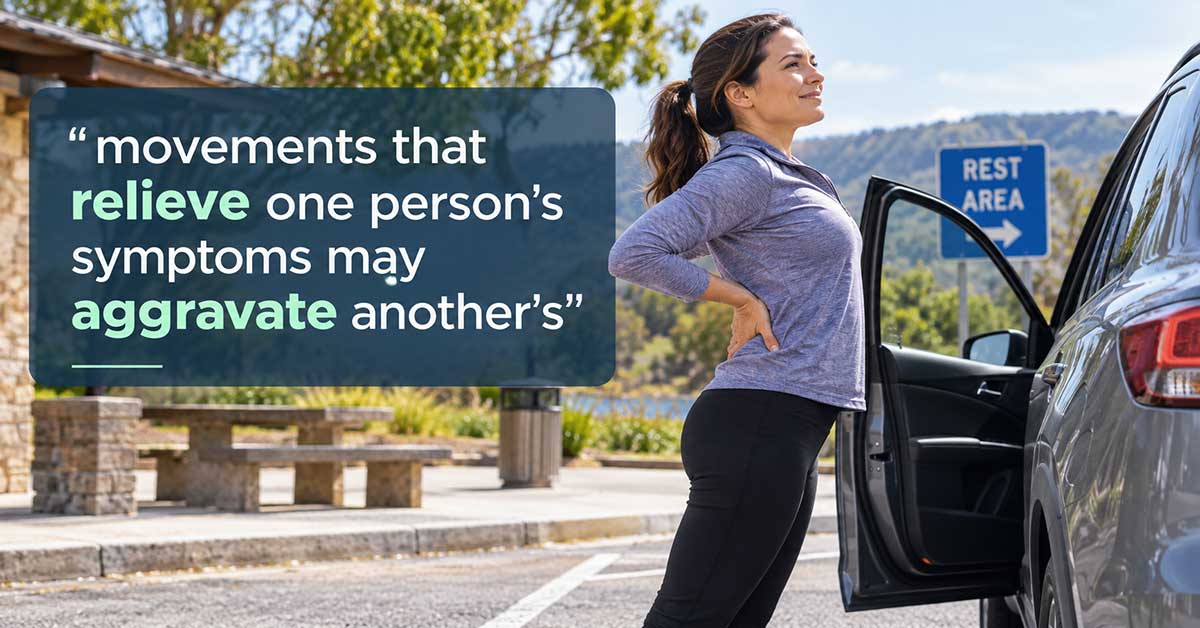
When back pain strikes during a long drive, the natural instinct may be to stop and stretch. That’s often a reasonable idea, but there’s an important distinction between ordinary muscle stiffness and symptoms involving an irritated nerve. Sciatica can have several underlying causes, and movements that relieve one person’s symptoms may aggravate another’s.
For example, some people find bending forward comfortable, while others experience increased symptoms in that position. Similarly, a stretch that feels good for tight muscles might worsen radiating leg pain in someone with nerve irritation. Rather than relying on a generic stretching routine, consider asking a physical therapist to recommend specific movements based on your individual assessment. A personalized plan might include exercises to improve mobility, strengthen supporting muscles, or help you find positions that reduce discomfort.
Give Your Back a Change of Scenery
Even with a comfortable seat, staying in one position for hours can leave you feeling stiff and uncomfortable. Plan occasional stops where you can get out, walk around, and change positions. If you’re flying, take advantage of safe opportunities to stand and move when permitted. You don’t need an elaborate exercise routine at every stop. A short walk and a little gentle movement may be enough to help you feel more comfortable before continuing your journey.
Plan Ahead for a More Comfortable Trip
If long car rides consistently trigger back pain or sciatica, don’t wait until you’re halfway across the country to think about solutions. A physical therapist can evaluate your movement, discuss the positions that aggravate your symptoms, and recommend practical strategies for traveling more comfortably. Individualized exercise, movement advice, and positioning strategies can make a meaningful difference for many people. If you experience new or worsening leg weakness, or changes in bladder or bowel control, seek prompt medical attention rather than treating the problem as ordinary travel discomfort.
This holiday season, a little preparation may help you spend less time thinking about your back and more time enjoying your destination.
Research References
Lee et al. (2018). Randomized clinical trial comparing gel and foam seat cushions among professional drivers with chronic low-back pain. Medicine. https://pubmed.ncbi.nlm.nih.gov/30290629/
De Carvalho and Callaghan (2015). Study of lumbar support preferences and discomfort during simulated driving. Human Factors. https://pubmed.ncbi.nlm.nih.gov/25952903/
National Institute for Health and Care Excellence (NICE). Low Back Pain and Sciatica in Over 16s: Assessment and Management. Guideline NG59. https://www.nice.org.uk/guidance/ng59